After a year of good work, we are excited to share the results of the San Juan Islands Grain Hub Feasibility Study. The concept was an opportunity brought to us at the 2025 SJC Agricultural Summit by Nathan Hodges of Barn Owl Bakery. Always eager to wrestle with infrastructure challenges impacting our local food system and long-term island resiliency, the Ag Guild was honored to support this exciting farmer-led solution.
Nathan shared a fantastic write up about the process and our findings in the most recent Barn Owl Bakery newsletter, which I’ve copied below. (If you aren’t signed up to receive their newsletter, I highly recommend it.) We were incredibly aware that we were teasing out a potential co-op infrastructure project while the SJI Food Hub and IGFC were under serious transition and financial reckoning. These kinds of projects are expensive with significant impact on our farmers, and when this essential infrastructure shakes, our whole local food system quakes. Having the right business model and people involved has proven to be critical. We enjoyed the opportunity to support Nathan and to collaborate with Abe Gates from Watmough Bay Farm, Josh DeWitt from Indigo Moon Farm, Andrew Jones from Still Light Farm, and Jake Fowler from the NABC on this initial step of a big idea.
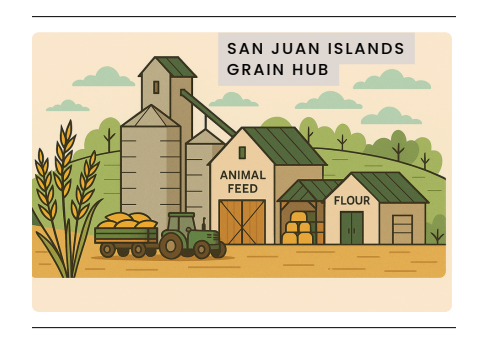
“Last year we received a grant from the NW & Rocky Mountain Regional Food Business Center to do a feasibility study and business plan in partnership with San Juan Islands Agricultural Guild looking at creating a Grain Hub here in the San Juans. The Grain Hub is imagined as a central facility that can store, dry, handle, process, mill, and sell grain, amendments, animal feed, and more. It would serve the whole San Juans but be based on Lopez, with a smaller outpost on San Juan. We conducted a survey of farmers in the islands and did our best to create a path forward that reflected the needs and opportunities for grain farming in our archipelago. Working with the NABC (Northwest Agricultural Business Center) we put together a business plan that outlined what services a Grain Hub might provide and the costs for those services and resulting products. The organizational structure we’re working with at this stage is a farmer co-op – a good idea in theory but as the Island Grown Farmer’s Co-op (originally created to supply on-farm mobile slaughter services to island farms, but since drifted from its core mission and is now facing bankruptcy) has shown great care is required at the outset to make sure that the organization stays true to its purpose.
One of our primary goals as we worked our way through this process was to make sure that even if it was a bad grain year or one of the larger farmers stepped back from grain or for any other reason the quantities of grain being handled by the Hub decreased, the infrastructure – the equipment and buildings – would still be there, be usable, and not run the risk of being sold off or foreclosed on (like we’re seeing with the Island Grown meat processing facility).
This is a tricky problem – after all for any entity and physical plant there are overhead costs – insurance, lease fees, staff salaries, equipment maintenance, utilities – that have to be covered by the profits generated by the operation. If the Grain Hub isn’t processing grain (or enough grain), how would it cover those baseline expenses? I can’t say we fully addressed that tension – after all the mission of the Grain Hub isn’t to create profits – it’s community owned and operated grain infrastructure that would be used by island farmers as needed to support grain farming in their fields for pasture improvement, more diverse hay crops, livestock feed, cover crops to build soil fertility and grains for human consumption. Given the scale and realities of island farming, grains aren’t profitable enough on their own to justify each farm investing in all the infrastructure grains need – but on a community scale there is the potential for a functional and productive grain economy if the infrastructure is in place to support the farmers.
At the end of the process the NABC created a business plan that outlined a possible path forward based on the results of the farmer survey, but still operating on some big assumptions about how much grain we could get grown in the islands – after all a grain hub needs farmers who grow grain and right now there’s just a handful of us – but the potential is there, the demand is there, the land is there – but the infrastructure is not. If we agree that this is something the islands need and we build it out, would it create a resurgence in island grain farming or would it be overkill for the few farmers who stubbornly hold out and put in the effort to still grow grain out here?
It’s a conversation and process that’s ongoing and we feel really good about the work we’ve done thus far and it’s been a blast to work with Lauren at the Ag Guild, Abe from Watmough Bay Farm, Josh from Indigo Moon Farm, Andrew from Still Light Farm, and Jake from the NABC to bring the vision of a Grain Hub one step closer to fruition. Not to mention all the helpful folks who give their thoughts as it comes up in the treasured conversations we have with seasoned island farmers, that is a resource we do not take for granted and use as much as we can.” — Barn Owl Bakery Newsletter
For anyone who is interested, the business plan can be downloaded here.