We are witnessing the final ownership cycle of a farming class that acquired land at prices
that no longer exist. What is the next generation of farmers to do?
Guest article by Jay Kimball
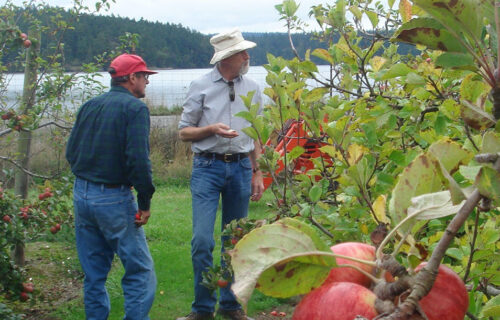
Strolling on island farmland, first worked in the 1880s, we might think of it as a fixed feature of island life, something that has always been here and always will be. The fields off the county roads, the hay rolled and stacked in early summer, the sheep on the hillsides — they read as permanence. But permanence is a story we tell ourselves. The most recent Department of Agriculture census tells a different story: a farming system quietly coming apart, as the land turns from livelihood to landscape.
This is an attempt to reckon with those numbers — where our community is heading demographically, what it costs to live here, who actually works our farms and what those farms earn, why the land has slipped beyond the reach of the people who would farm it, and what accelerating climate disruption is about to add to the bill. It is not a comfortable picture. But it ends with something better than a lament, because the same forces squeezing our farmers also open a door to more local food, affordable farming and climate resilience.
Our island community is aging out
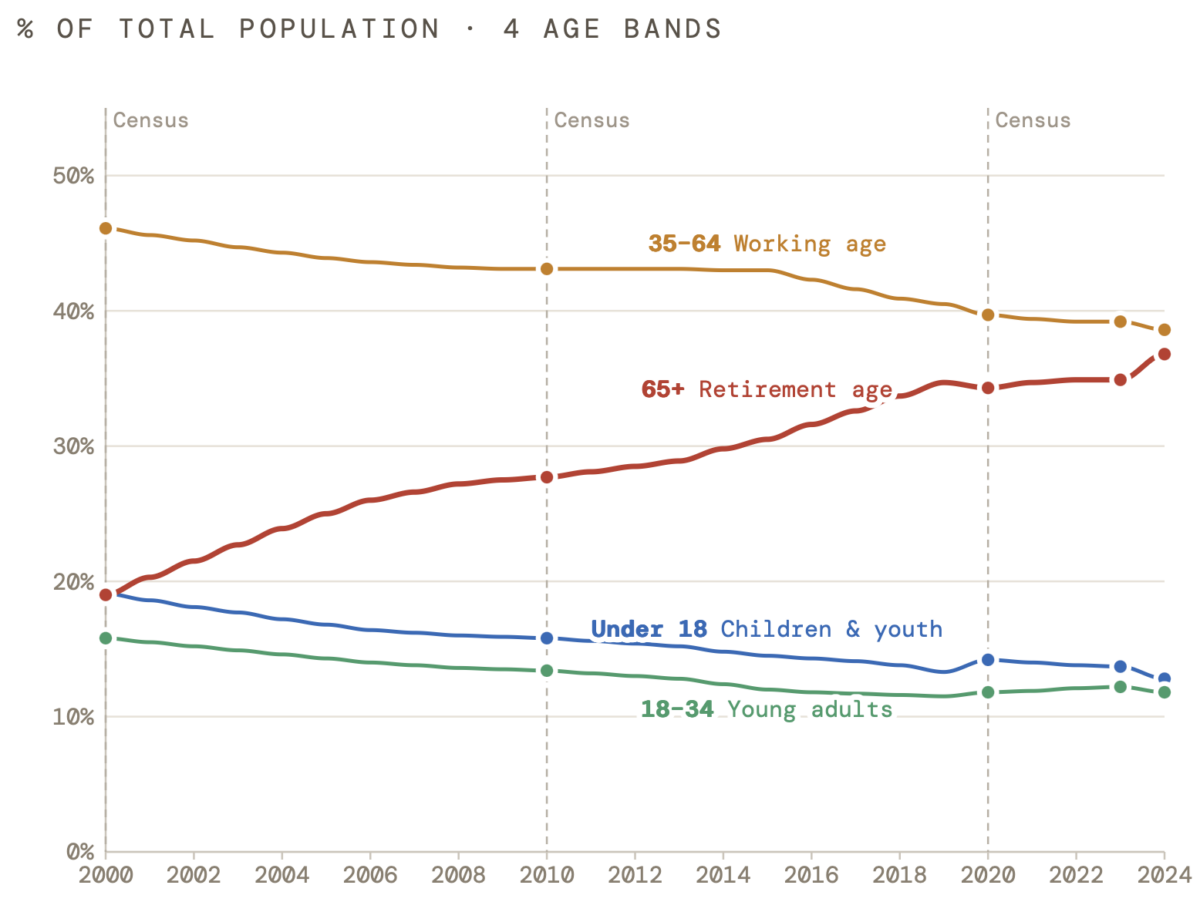
Start with the most basic fact about who we are. Over the last quarter century, San Juan County has aged faster than almost any community you could name. The 65-and-older cohort is the only age group that is growing — doubling from 19 percent of the population in 2000 to roughly 38 percent today. Every other age group is shrinking.
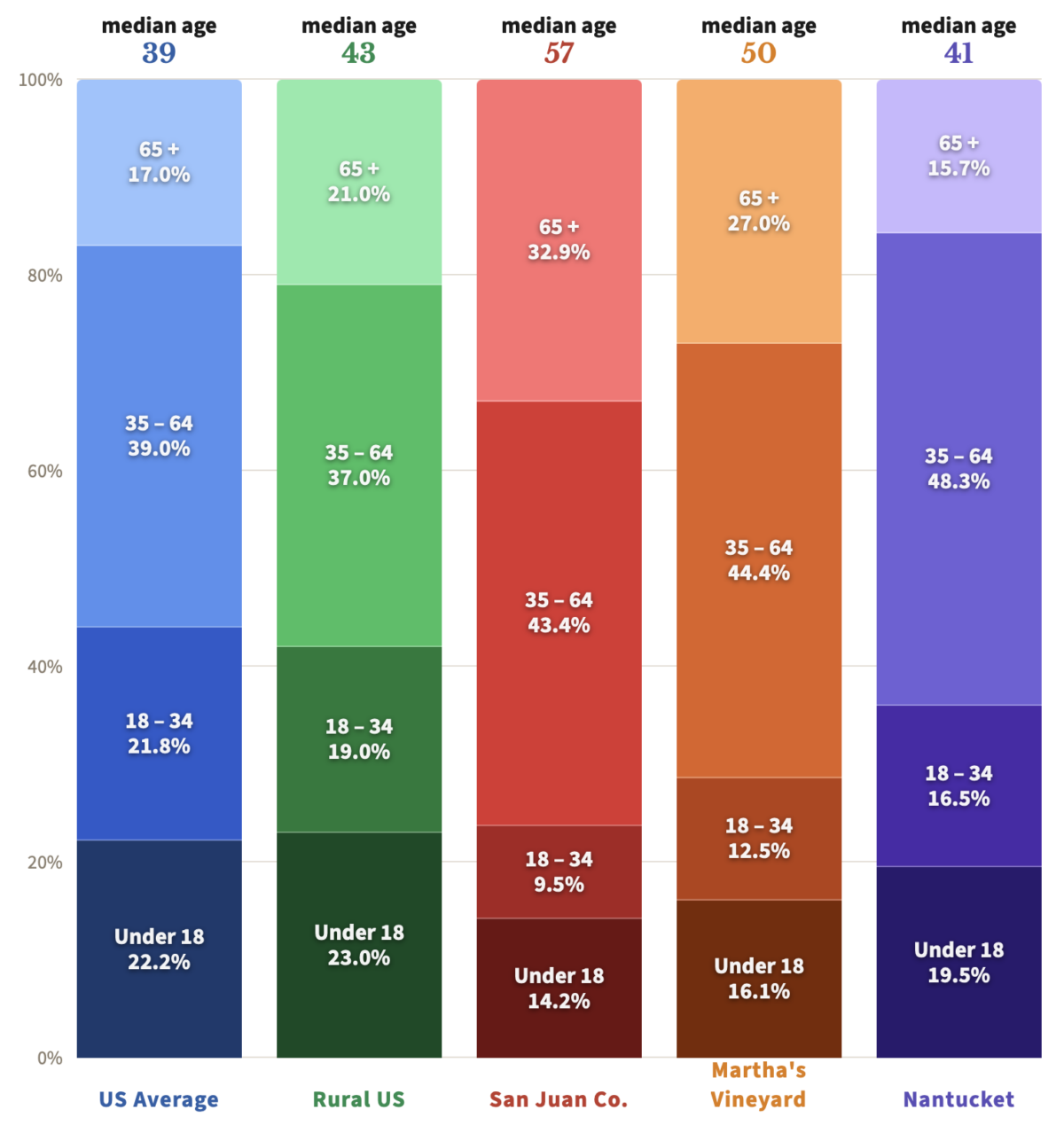
Set our age structure beside other places and the divergence is stark. The U.S. median age is 39. Seattle’s is 36. Even rural Washington and rural America as a whole sit in the low-to-mid 40s. San Juan County’s median age is 57 — older than Martha’s Vineyard and Nantucket, the island communities we are often compared to. Barely one resident in ten here is between 18 and 34, the years when people typically start careers, buy first homes, and begin farming. The demographic engine that replaces one working generation with the next is running on fumes.
A dual economy
None of this happens in a vacuum. It is the predictable result of what it costs to live here and where the money comes from.
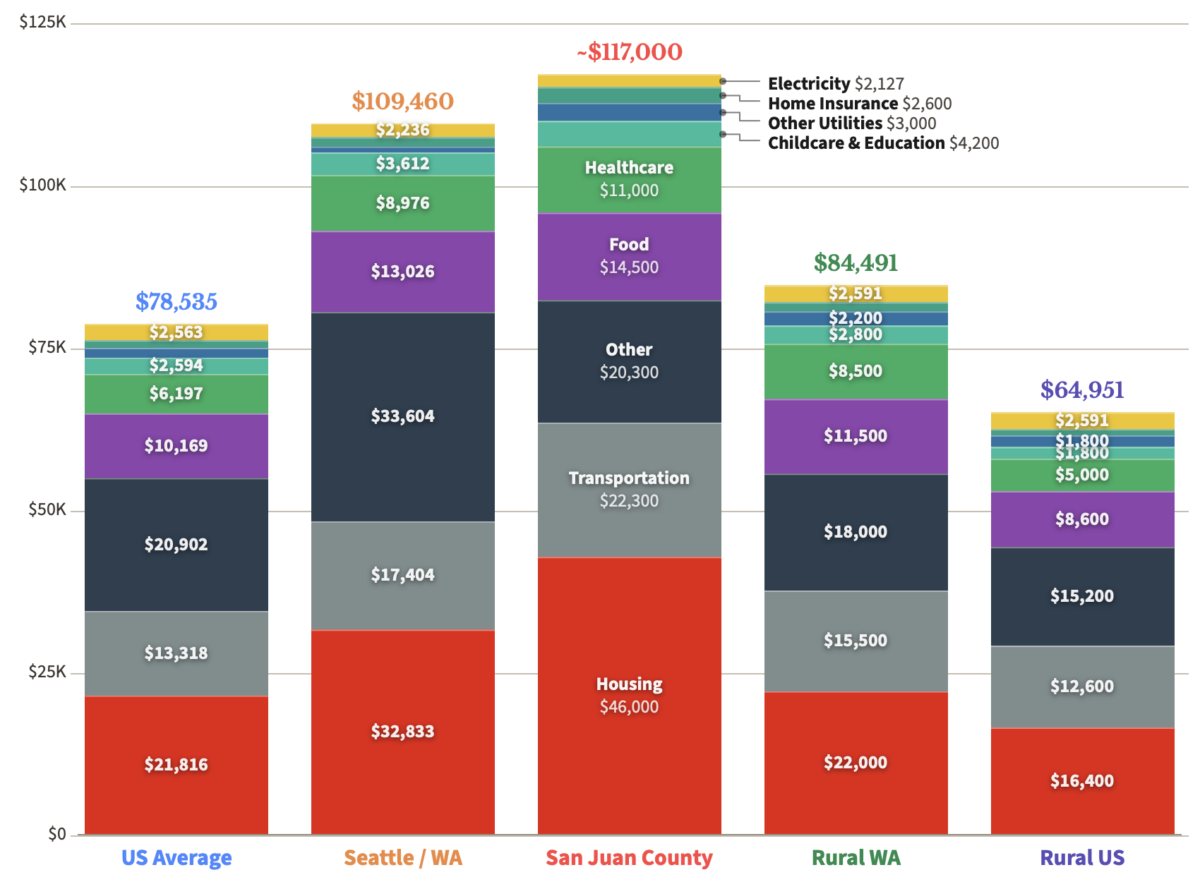
The average San Juan County household now spends on the order of $117,000 a year — well above the U.S. average, above even the Seattle metro, and far above rural Washington or rural America. Annual housing costs alone runs near $46,000. Ferry-dependent transportation, groceries, island-premium fuel, healthcare priced for an older population, utilities, childcare — as the cost breakdown shows, each line item carries a surcharge for the privilege of living at the end of a boat ride.
The deeper story is not the cost; it is the split in who can afford it. A careful look at income in the county reveals two economies sharing the same zip codes:
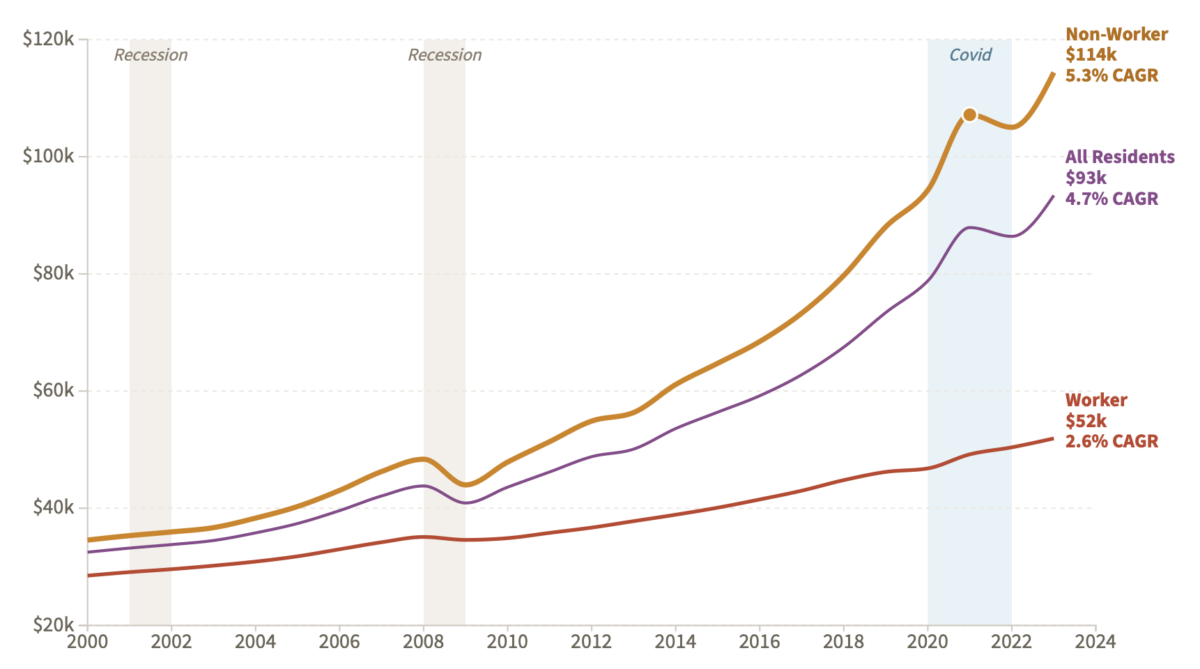
Worker wages — what people actually earn from a job here — have grown slowly, to a per-worker average around $52,000, barely keeping pace with inflation.
Non-worker income — Social Security, pensions, dividends, capital gains, the proceeds of assets held elsewhere — has grown more than twice as fast, to about $114,000 per non-worker. The gap is not closing; it is widening with every passing year, as the diverging income lines make plain.
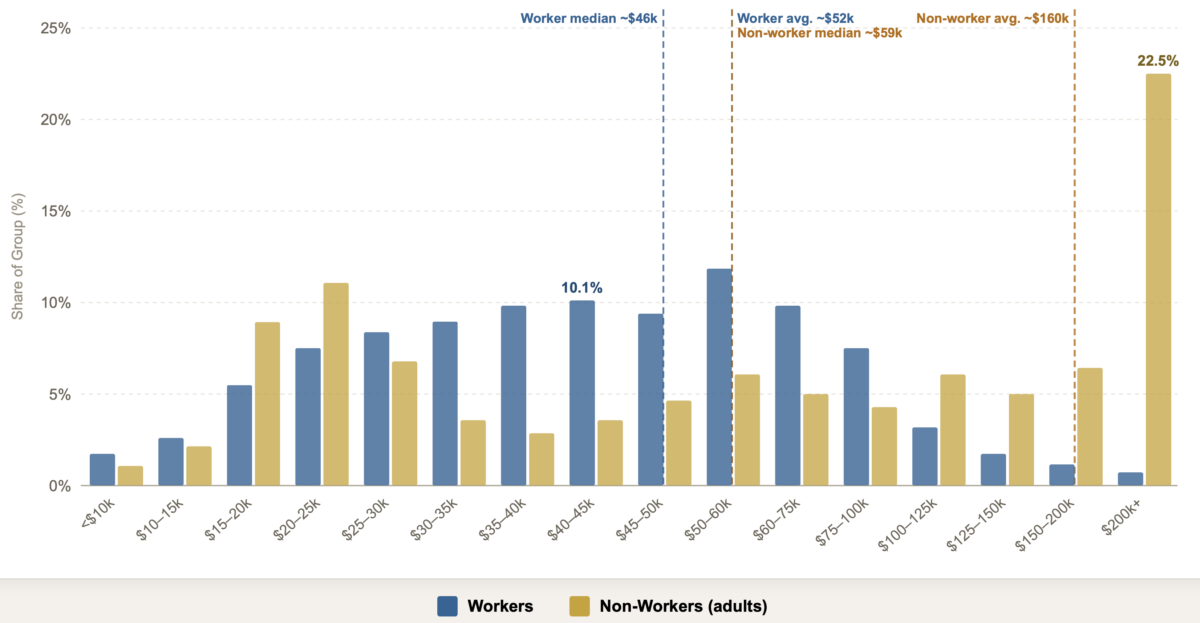
Looking at the distribution we see the median working household earns about $46,000, while more than a fifth of the county’s non-working adults report incomes above $200,000. We are, functionally, a community of modest wage-earners living inside a community of affluent retirees, second-home owners, and investors — and the second group drives the prices.
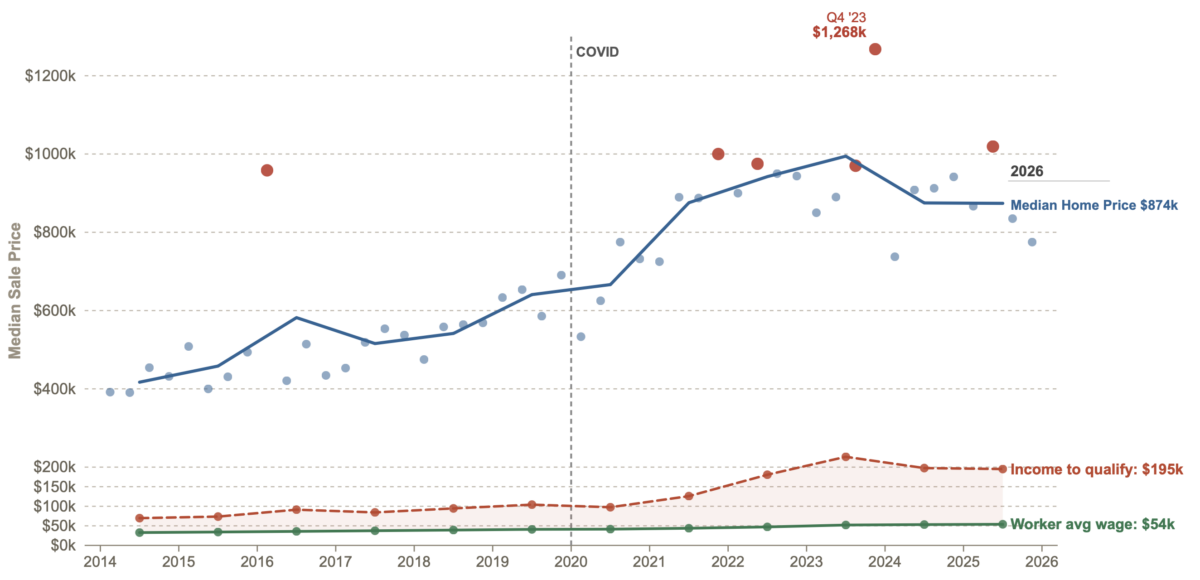
Nowhere is that clearer than in housing. The median San Juan County home has more than doubled in price since 2014. Track the income required to qualify for a mortgage on a median-priced home against the average worker wage, and the two lines pull apart into open space: roughly $195,000 needed to qualify today against a worker wage now near $54,000. That widening gap is the precise measure of a community pricing out its own workforce. Hold that image. The farmland story is the same story, only worse.
Our farming community — an aging microcosm
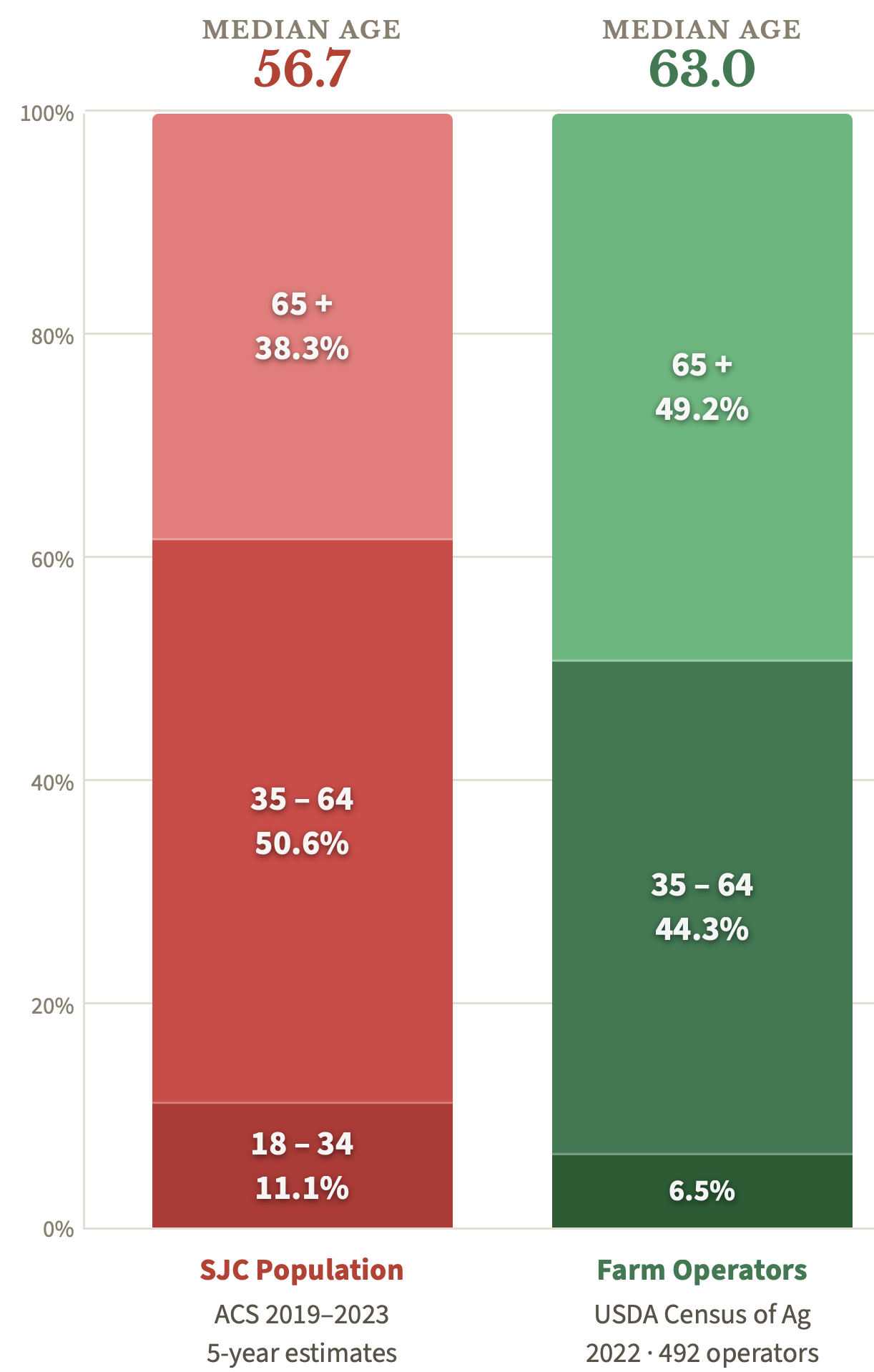
If the county as a whole is aging, its farmers are older still. Across five agricultural censuses from 2002 to 2022, the share of farm operators 65 and older nearly doubled, from 25 percent to 49 percent, while the working-age majority that once ran our farms shrank from 71 percent to 49 percent. The bars below make the inversion vivid: a sector that has flipped from predominantly working-age to predominantly retirement-age in two decades.
The median farm operator in San Juan County is now about 63 years old — older than our already-elderly general population. Of 492 reported producers in the most recent census, 242 were 65 or older and just 32 were under 35: nearly an eight-to-one ratio of operators near retirement to young entrants. The community that stewards our agricultural land is a generation older than an already-aging county, and it is barely replenishing itself.
This matters because working farms depend on long hours of physical labor, on the accumulated knowledge of a particular piece of ground, and on someone willing to take the operation forward when the current steward steps back. On the current trajectory, for a great many of these farms, the next generation can’t afford the price.
The brutal arithmetic of the farmer’s acre
Why aren’t younger people stepping in? Begin with what the land earns.
San Juan County has roughly 7,900 acres of cropland, and more than half of it is in generally low-value forage and hay. Higher-value crops occupy a sliver — vegetables account for barely one percent of cropland acres.
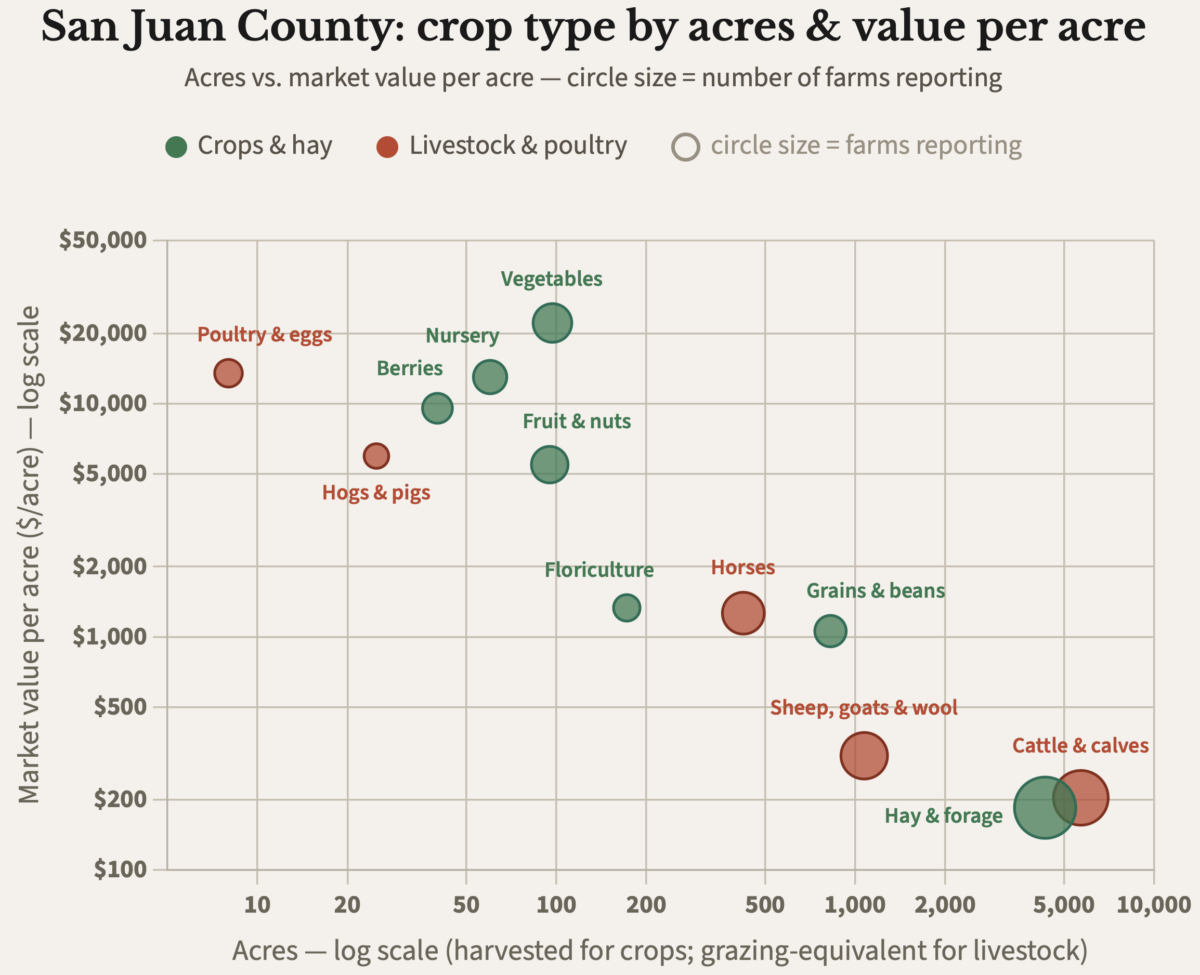
Which leads to the question, what counts as a farm? The Census of Agriculture counts any place that produced and sold — or normally would have sold — at least $1,000 of agricultural products in the year. That low bar means the county’s 264 farms span an enormous range, from a handful of substantial commercial operations to many small parcels producing just enough to clear it.
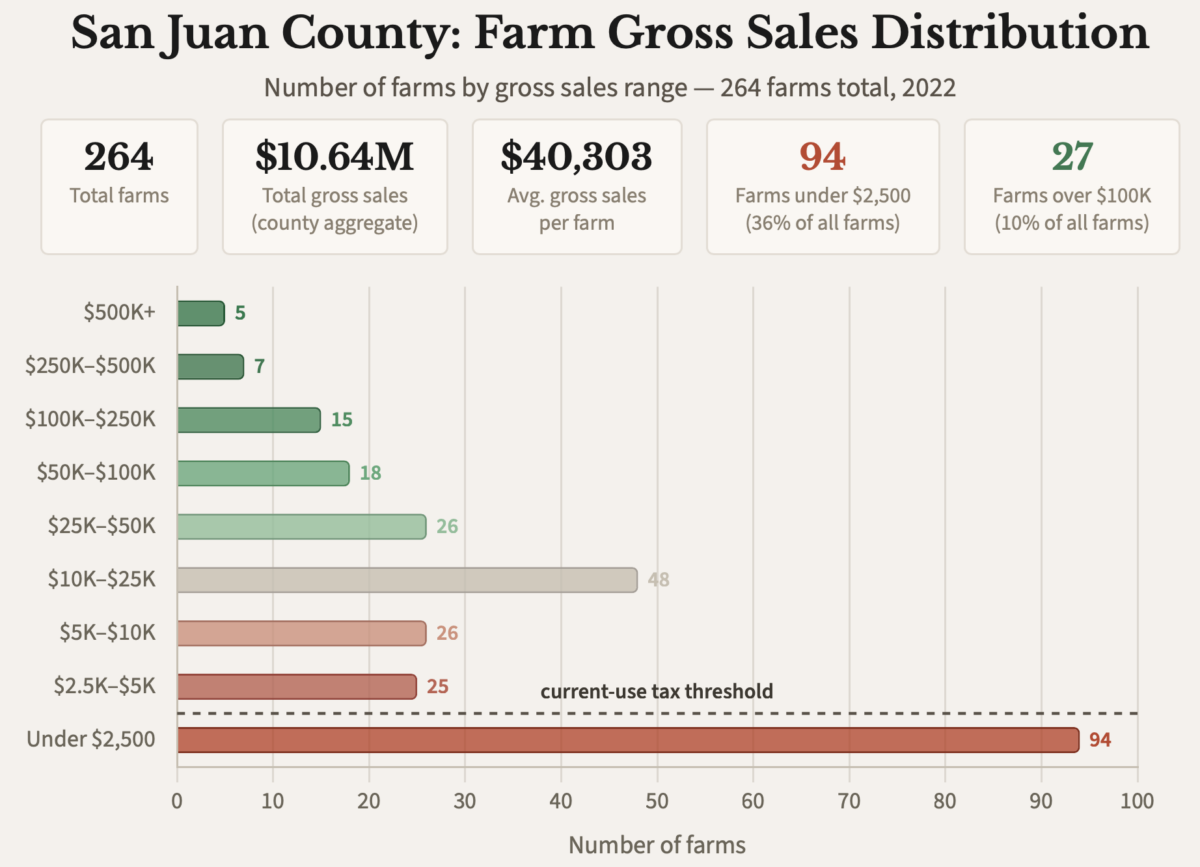
That range matters, because two different things are happening inside it. Some are working commercial farms, and a sobering share of them lose money for structural reasons — input costs, the price of land, and a scale too small to absorb either. Others are small or part-time holdings, including parcels kept in production largely to maintain Washington’s current-use agricultural tax classification, which can require as little as $200 per acre in annual sales — a bar a modest hay or livestock operation can clear. The first is a real economic-viability problem for people who farm for a living; the second is mostly a feature of how tax policy shapes land use. They are different issues, and it’s worth not conflating them.
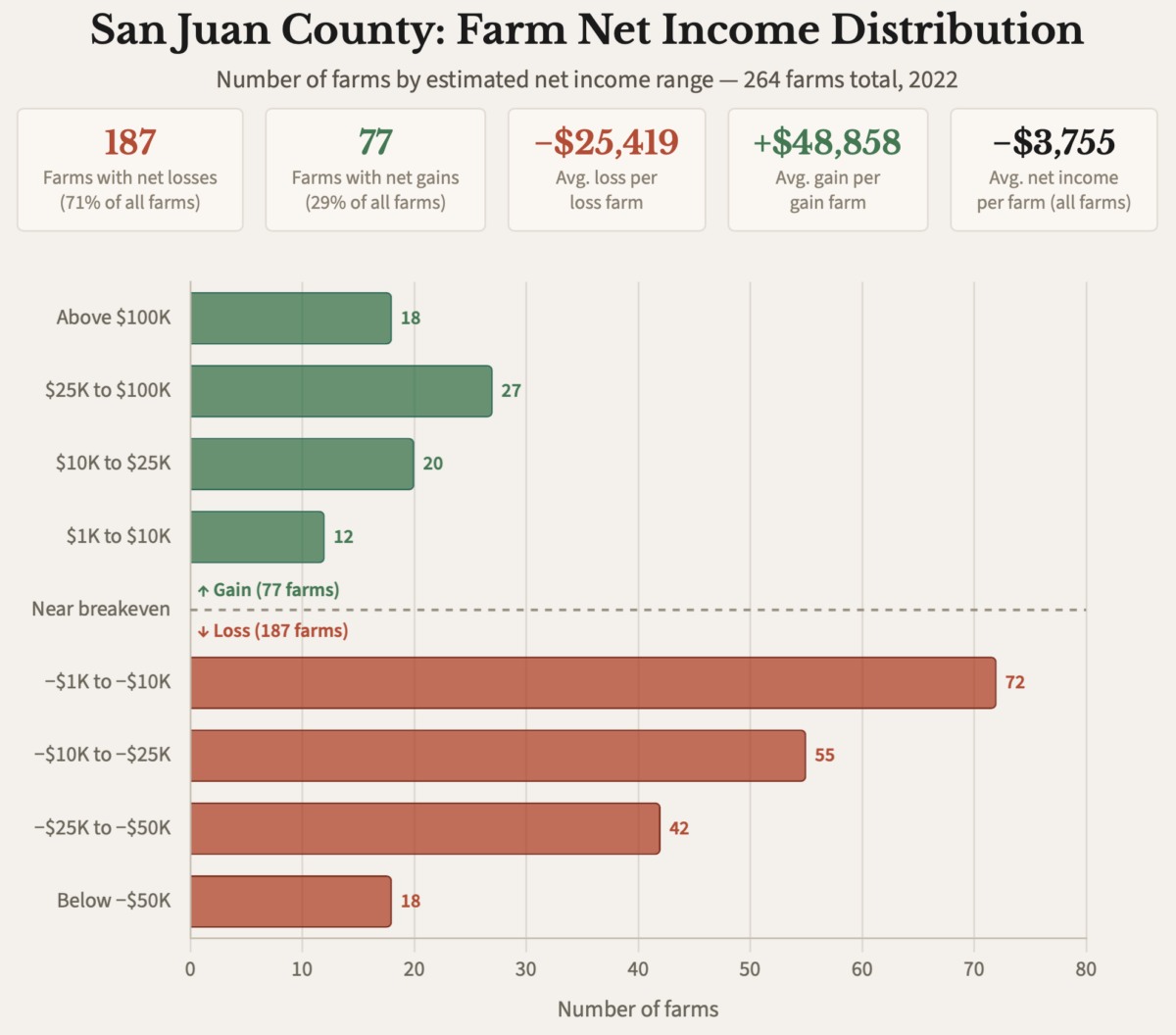
Read with that in mind, the aggregate is still sobering: of the 264 farms, 187 — roughly 71 percent — operated at a net loss in the most recent census year, and county farming as a whole lost close to a million dollars. The spread is wide — only about 10 percent of farms clear $100,000 a year, while about 36 percent sell less than $2,500. But the point that matters most is hidden inside the average: the working commercial farms, the ones genuinely trying to make a living from the land, are not failing because they’re hobbies or tax shelters. Many are failing despite doing everything right, because the math of farmland at island prices simply doesn’t compute.
And the labor that does the work is precarious. Only about a quarter of farms hire any paid labor at all; nearly a third rely on unpaid family members. Of the 287 hired farmworkers in the county, more than three-quarters are seasonal, at an estimated wage near $15 an hour — on islands where the average household needs $117,000 a year to get by.
A closed door
A farmer at median agricultural wages cannot buy the land they farm, just as a
service worker at median wages cannot buy the house they live in.
Here is where the two stories — housing and farming — fuse into one.
A working San Juan County farm, priced at current land rates, carries a market value of roughly $1.5 to $2 million. For parcels in the 20-to-100-acre range, the county commands some of the highest prices in Washington — driven not by what the land produces but by scenery, island scarcity, and competition from buyers for whom a working farm doubles as a rural estate. Against that valuation, the average farm grosses about $40,000 and spends about $47,000 to do it. No lender underwrites a seven-figure purchase against a negative operating margin.
The public programs meant to help can’t bridge a gap this wide. The USDA’s Direct Farm Ownership loan tops out at $600,000, and the most accessible beginning-farmer pathway caps the federal contribution near $300,000, asking the applicant to finance the rest commercially. On a $1.5 million farm, the federal ceiling covers about twenty cents on the dollar. The aspiring farmer is expected to find the other $1.2 million on the private market — at interest the land’s farm income cannot possibly service.
Farmland here has become, in economic function, a tax-advantaged amenity asset. The conservation-easement layer complicates the picture in a humane but telling way: the Land Bank holds easements on 29 operating farms and leases some 500 acres to working farmers and ranchers — a genuinely vital intervention, but one that preserves agricultural use by replacing ownership with tenancy. It keeps land in production while making owner-operator status permanently out of reach for anyone without inherited wealth.
The parallel to housing is not rhetorical; it is structural. In both cases the underlying asset has been bid up to a price that reflects the purchasing power of the wealthiest buyers, not the income of the people whose labor gives the asset its social value. A farmer at median agricultural wages cannot buy the land they farm, just as a service worker at median wages cannot buy the house they live in. But farmland loss compounds: once land exits agricultural ownership, it tends to stay out, because the economics of returning a $2 million parcel to production are simply impossible.
None of this is a complaint about the people who own land here. Many large landowners are devoted stewards who keep their ground open and actively support the farms and farmers around them — and conservation-minded owners, together with the Land Bank’s easements, are part of what has held the line this long. The problem isn’t who owns the land; it’s a pricing-and-tax structure that, left unchanged, slowly turns working farmland into something else.
The age structure of local farmers tells us how this ends. When today’s operators exit — through retirement, incapacity, or estate settlement — much of this land will not pass to working farmers. It will pass to whoever can write the largest check, which on these islands often means high-income, second-home buyer, a trust, or a conservation organization with philanthropic capital. We are not watching a transition between farming generations. We are watching the final ownership cycle of a farming class that acquired land at prices that no longer exist.
A different model — and an open door
In places like France and Japan, Colorado and Oregon, communities facing versions of our problem have begun testing a different model. The structural trap, it turns out, has a structural escape, and it begins by noticing that nearly every constraint above points to the same insight: the especially hard part is not the farming itself — it is the ownership math and the low value our land returns per acre.
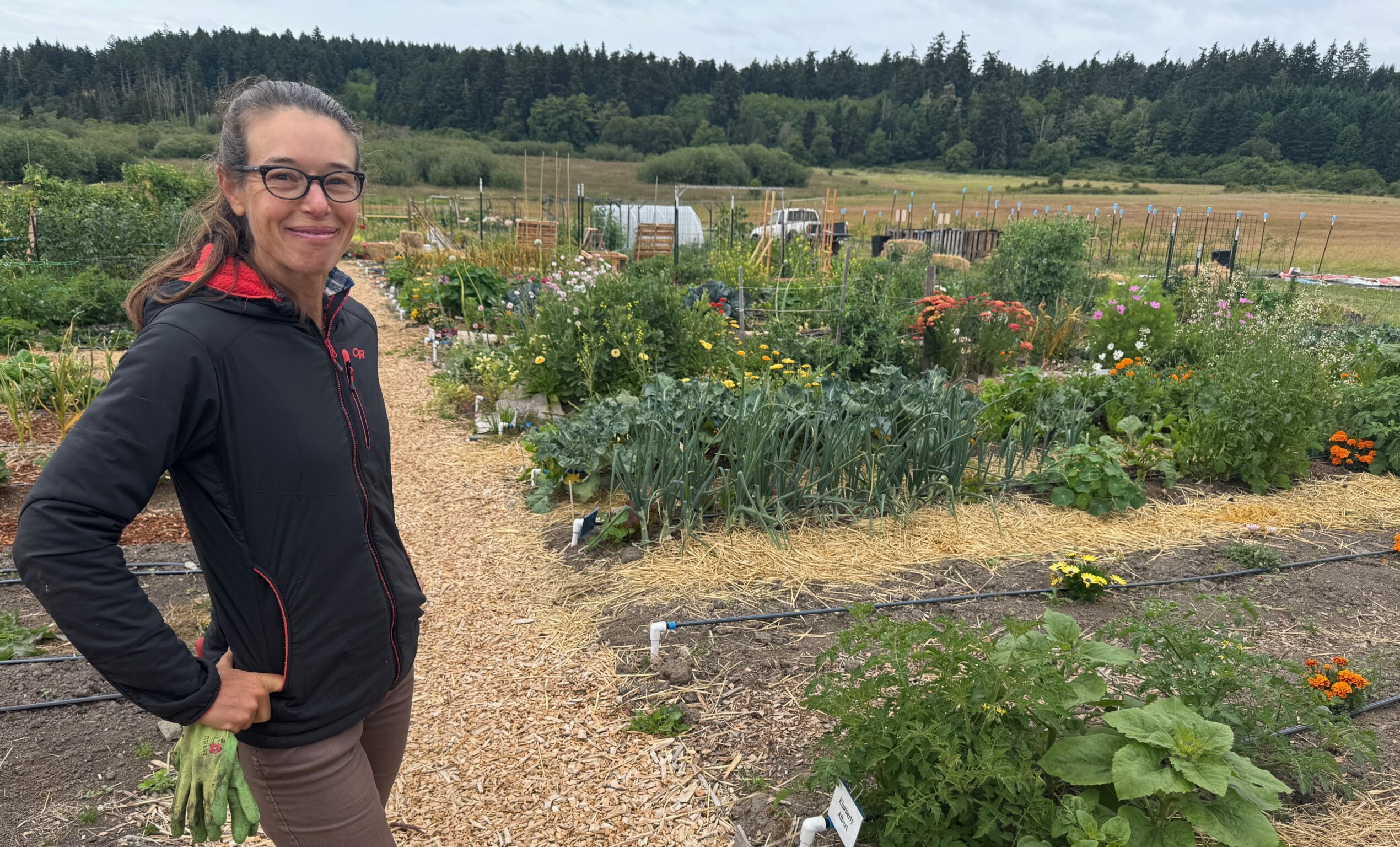
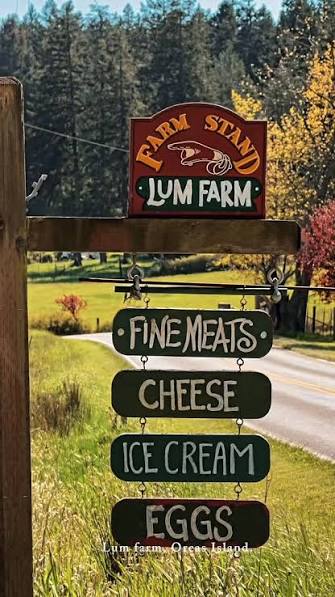
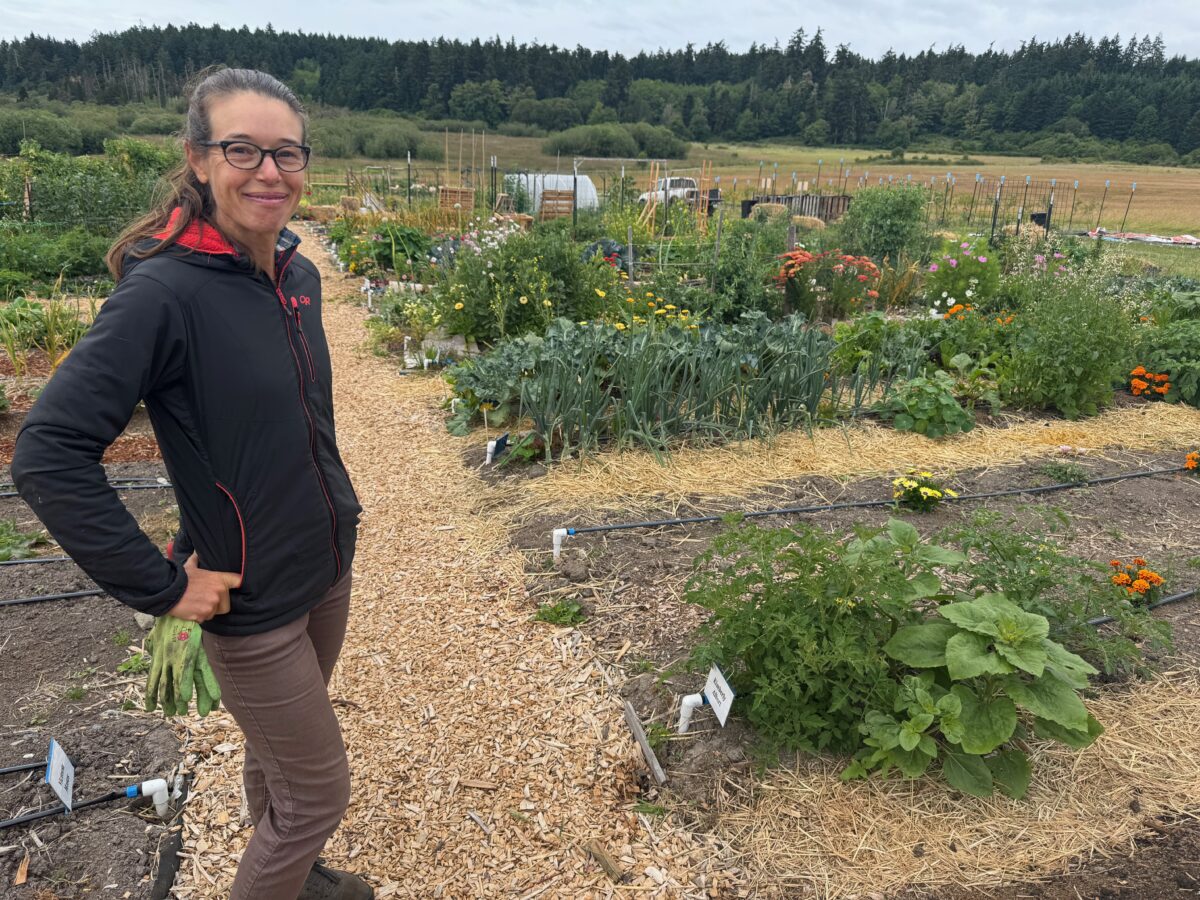
On ownership — and this is the piece with the longest track record — the most promising idea is to separate land ownership from farm-enterprise equity. In a farmland commons, a community land trust owns the land in perpetuity and removes it permanently from speculation, while the farmer builds real equity in what the farmer actually creates — buildings, soil health, the business itself — through secure, long-term, affordable leases governed by the leaseholders and the community together. It is the clean break from the $2 million cost basis that no working farmer can carry, and versions of it are already at work in farm trusts across the country. We need look no further than our own islands for early signs of what this can look like: on Orcas, Lum Farm operates a thriving working farm on the Land Bank’s Coffelt Preserve, and on San Juan Island, the Grange’s Overmarsh Farm Commons has opened conserved land to dozens of growers priced out of the market. Both rest on the same insight — public land, off the speculative market.
The choice in front of us
I should be honest about something I’ve heard repeatedly while sharing this research — from farmers, from a county council member, from people who have spent their lives close to this land. More than one of them has told me, plainly, that they doubt island farming can be saved at all — that the economics simply don’t work and aren’t going to, and that no amount of restructuring changes the underlying math. I don’t dismiss that view. The people who hold it know things about farming these islands that no Ag Census captures, and the numbers in this piece give them plenty of grounds. They may be right.
But I’d offer a distinction worth sitting with. The question is not whether farming as it is currently structured is sustainable — on that, the doubters may well be correct; the data here largely agrees with them. The question is whether a differently structured model could change the answer. That’s a genuinely open question, not a settled one. It deserves to be tested honestly, including the possibility that the test fails.
What the numbers do make clear is that doing nothing is itself a choice, and not a neutral one. An aging county, a dual economy, land priced as an amenity rather than a livelihood, a farm sector below break-even, and climate disruption stacking new pressures on top — these are not separate problems. They are one system, and on its current trajectory that system retires our last generation of owner-operators and does not replace them. The land changes hands either way over the next two decades; that much the demographics guarantee. The only open question is to whom, and on what terms.
And the stakes run deeper than any single livelihood. Nearly everything we eat arrives across the water, on a supply chain no more reliable than the ferry schedule and the price of diesel. Food is the foundation beneath every other layer of a community’s life — the base of the pyramid, the thing that must hold before anything above it can stand. A county that aspires to reduce our dependence on the mainland cannot get there while the land that could feed us slips, parcel by parcel, into estate lawns and tax shelters. Keeping these acres in working hands is not nostalgia for a rural aesthetic; it is the most basic kind of resilience a place can build for itself.
So I’ll end not with an answer but with a question, and a genuine request. What is your vision for affordable, sustainable farming in the San Juans — community land trusts, farmland commons, climate-resilient agrisolar, something we haven’t tried yet? If you farm here, or once did, or hope to, or simply care whether these fields stay in food, let’s hear what you see. The choice in front of us is whether this good earth goes on feeding us, or comes to frame a nostalgic view — and that’s not a choice any one of us makes alone.
Sources: USDA National Agricultural Statistics Service, 2022 Census of Agriculture (San Juan County profile); U.S. Census Bureau, ACS 2019–2023 5-Year Estimates; BEA Regional Economic Accounts; WA Employment Security Department QCEW; Washington Center for Real Estate Research, UW; BLS Consumer Expenditure Survey; WA Department of Ecology; NASA Goddard Institute for Space Studies (Hansen et al., Feb. 2026); American Farmland Trust; San Juan County Land Bank; Oregon State University (C. Higgins, Solar Harvest); NREL; EPA. Analysis and modeling by 8020 Vision.